-
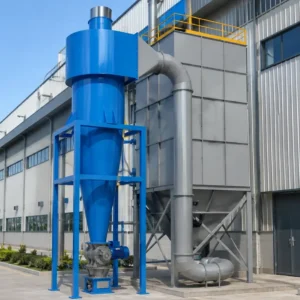
High-efficiency cyclone separators that use centrifugal force to remove coarse particulates from industrial air streams before further filtration. A cost-effective first stage of dust control, these units reduce load on downstream filtration equipment while handling high volumes of dust-laden air in manufacturing and processing environments.
Technical highlights:
- Centrifugal separation typically achieves 90%+ efficiency on particles above 10 microns
- Operates at pressure drops of roughly 2 to 10 inches water column depending on design
- Tangential inlet design creates the vortex needed for particle-to-gas separation
- No moving parts or filter media, resulting in low maintenance and continuous airflow
- Commonly used as a pre-collector to extend the service life of downstream baghouse or cartridge filters
- Constructed in carbon steel, abrasion-resistant plate, or stainless steel depending on dust characteristics
-
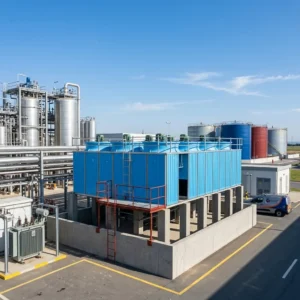
Engineered forced draft towers that support controlled airflow and gas conditioning within industrial pollution control systems. Built for structural stability at height and consistent performance under variable operating loads, these towers are a key component in multi-stage emissions control setups.
Technical highlights:
- Fan-driven forced draft configuration with blower positioned at the tower base for accessible maintenance
- Engineered fill/packing media to maximize air-to-gas or air-to-water contact surface
- Compact footprint relative to natural draft designs, suited to constrained industrial sites
- Structurally engineered for stable operation under variable load and wind conditions
- Compatible with multi-stage gas conditioning and cooling process requirements
- Corrosion-resistant construction options for aggressive gas streams
-

Custom-engineered capture hoods designed to contain fumes, dust, and particulates at the source before they disperse into the workspace. Built for seamless integration with existing extraction systems, hygienic hoods help facilities maintain cleaner air quality and meet workplace safety standards without disrupting production flow.
Technical highlights:
- Custom hood geometry engineered around the specific emission source for maximum capture efficiency
- Designed to minimize cross-drafts and thermal updrafts that carry particulate past the capture zone
- Fabricated from corrosion- and heat-resistant sheet steel or stainless steel as process demands
- Sized for target face velocity to ensure effective capture without excess exhaust volume
- Direct ducted connection to downstream cyclone, baghouse, or scrubber systems
- Supports compliance with workplace exposure limits for fume, dust, and particulate
-
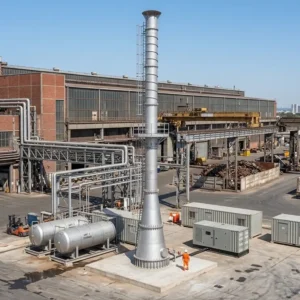
Tall, structurally engineered chimneys designed for safe dispersal of exhaust gases from industrial processes. Fabricated to meet environmental and structural safety standards, each chimney is custom-sized and reinforced to handle site-specific height, load, and gas-flow requirements for long-term operational reliability.
Technical highlights:
- Self-supporting steel stack design engineered per applicable structural and wind-load codes
- Height and diameter calculated from flue gas volume, temperature, and required exit velocity
- Recommended flue gas exit velocity generally in the 15 to 20 m/s range for effective dispersion
- Structural design accounts for wind pressure, seismic load, and terrain category
- Available in flared or straight-shell configurations depending on dispersion requirements
- Fabricated in carbon or stainless steel with corrosion allowance for flue gas composition
-
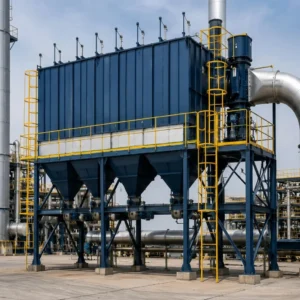
Advanced pulse jet baghouse filtration systems designed for fine particulate capture in large-scale industrial operations. Using automated pulse-cleaning cycles, these systems maintain consistent filtration efficiency with minimal manual intervention, making them well suited for continuous-duty applications in smelting, cement, and process industries requiring strict emissions compliance.
Technical highlights:
- Air-to-cloth ratio typically engineered in the 3:1 to 4:1 CFM/ft² range for reliable long-term performance
- Automated compressed-air pulse cleaning dislodges dust cake without taking the system offline
- Filter media selection (woven or non-woven/felt) tailored to dust type, temperature, and moisture content
- Continuous online operation, avoiding the production interruptions of shaker/reverse-air designs
- Captures fine particulate down to sub-micron range, supporting strict emissions compliance
- Modular bag/compartment design allows sectional maintenance without full shutdown
-
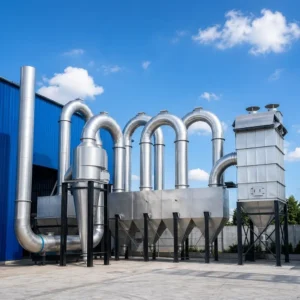
Custom-designed scrubber systems that remove harmful gases and particulates from exhaust streams through wet or dry scrubbing processes. Built for large-scale manufacturing environments requiring stringent air quality control, these systems are engineered to handle high gas volumes while ensuring compliance with environmental regulations.
Technical highlights:
- Wet scrubbing systems capable of 95%+ removal efficiency for particulates and acid gases above ~5 microns
- Liquid-to-gas (L/G) ratio and contact time engineered around specific pollutant load and gas composition
- Suitable for corrosive, high-humidity, or high-temperature exhaust streams
- Available in packed-bed, venturi, or spray-tower configurations depending on application
- Constructed in corrosion-resistant materials (FRP, PVC, polypropylene, or lined steel) for chemical compatibility
- Designed to handle acid gases (HCl, SO2, Cl2), particulates, and process fumes